“The End”
July 11, 2024


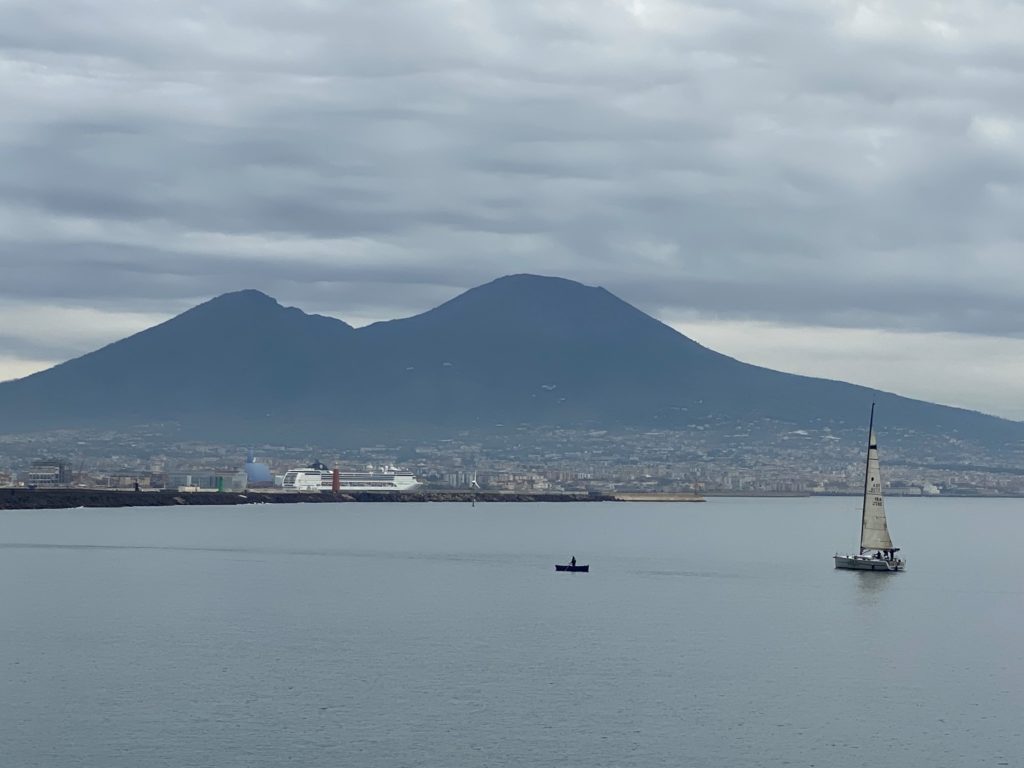
Last October I did a writing residency in Naples, Italy. It coincided with a terrible time in my life, and to deal with my grief, I walked (and walked and walked). It didn’t take long for me to realize how Vesuvius dominated the landscape.
I couldn’t see it from my window, but I frequently walked down Via Santa Teresa degli Scalzi to the promenade along the Tyrrhenian Sea, where I could behold the full glory of the volcano that destroyed Pompeii. I came even more to appreciate the way I’d turn down a narrow cobblestone street and there, between the four-hundred year old apartment buildings, would be an unexpected, thrilling glimpse of Vesuvius. For whatever reason, I always found the sight reassuring.
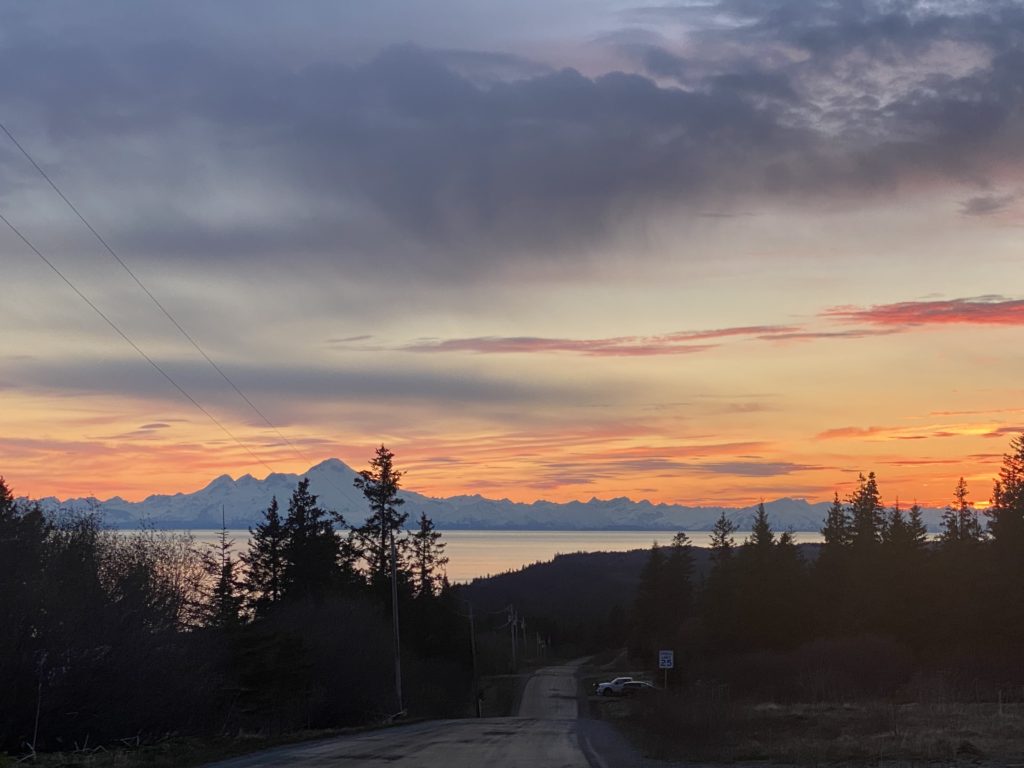
Now, seven months later, I’m at another residency, Storyknife Writers Retreat outside Homer, Alaska, and the window of my writing cabin frames three volcanoes – Augustine, Iliamna and Redoubt. Iliamna is in the center, somehow befitting her status as the largest.
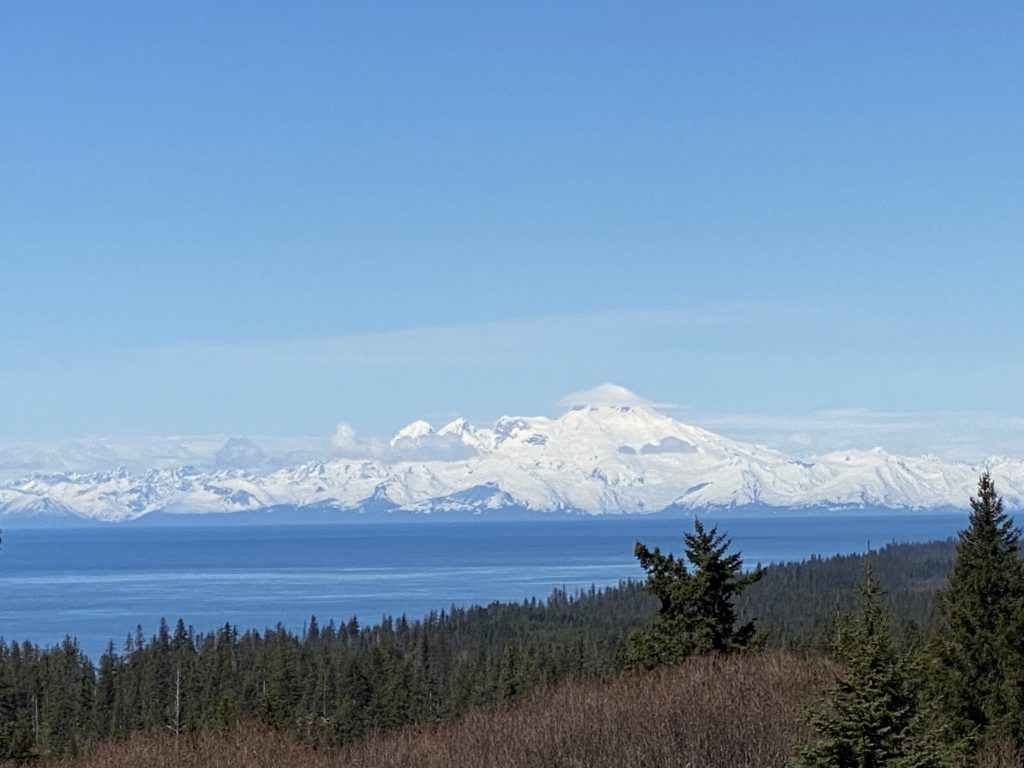
According to the National Park Service, Iliamna stands more than 10,000 feet tall, with 10 glaciers, and last erupted in 1867. She – anything with such beauty and power must be female, right? – remains active.
The name is Dena’ina, and references a legendary giant blackfish in Lake Iliamna that swims up from the depths to bite holes in boats, according to the Dictionary of Alaska Place Names.
Today, as I gaze across Cook Inlet, Iliamna is sunlit, with a bit of vapor trailing from her peak. I’ve taken countless photos of her, at all times of day and night, and no doubt will add a couple hundred more before my monthlong residency ends.
Like Vesuvius, she’s capable of immense destruction. But also as with Vesuvius, I find her presence reassuring – magnificent and mighty, reminding we humans of our own insignificance. Come to think of it, that may be what I like best about volcanoes.
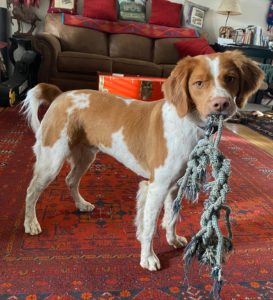 On the advice of my agent, I’ve started a monthly newsletter. How is it different than this space? For starters, it obviously appears more frequently, although I intend to remedy that. You can sign up here for book news, my baking successes (and inevitably some failures) and to see the remnants of the most recent special something Arlo has chewed to bits. Check out his patented sorry/not sorry expression in the photo. With two years of Covid restrictions finally lifting, it’s turning into a busy year, with more events, readings and workshops. Check out the events page for updates. I can’t wait to meet with readers and other writers in real life! Hope to see you out in the world.
Writing residencies are a gift beyond measure, offering time and space away from the many (many, many) demands of daily life that conspire against productive writing.
Typically they involve anywhere from two weeks to a month and beyond, sometimes in a separate cabin or apartment, or maybe a room in a main building, and often meals are provided. And many involve that beautiful word that makes every poverty-stricken writer’s heart beat a little faster: FREE. (For a listing check out the Artist Communities Alliance.)
I’ve been fortunate to have been selected for some over the years and each has been a boost to both my writing and my fragile little ego, given the affirmation involved. But one sat at the top of my wish list. Alaska has been on my bucket list for years, and when I saw that one of my favorite crime writers, Dana Stabenow, had created the Storyknife Writers Retreat in Homer, on the Kenai Peninsula, I started applying — and getting rejected. Story of the writing life, right?
Until this year when the writing gods smiled and I opened an email to find I’d been accepted for a monthlong residency in May. It’s been an unspeakably bad year on the personal front, and this news shot a ray of hope into a very bleak time. Among the many terrific things about Storyknife is that it’s for women writers; that it offers fellowships for Alaskan Native or Indigenous writers, and also for writers of popular fiction and crime fiction — sometimes overlooked in favor of work viewed as more literary.
I’ve got a special project in mind for my time there, so for the next 20 weeks (but who’s counting?) I expect to be X’ing off the days on the calendar like a prisoner waiting to bust out of her cell and jump on the next plane to the Halibut Fishing Capital of the World.
Gratitude. So much gratitude.
It was a thrill to schedule my first in-person book events in more than a year.
I signed up for Bouchercon, the world mystery book convention, in New Orleans – a location that doubles the fun of my favorite writers’ conference. I scheduled readings at two Montana independent bookstores, Fact and Fiction in Missoula and This House of Books in Billings, to coincide with the releases of The Truth of It All and Best Kept Secrets. And I was scheduled for two different panels at the Montana Book Festival with writers whose work I really admire.
I couldn’t wait!
Except, I – along with everyone else – will have to.
Thanks to a resurgence of COVID, Bouchercon went virtual and the Montana Book Festival is going to do likewise. No word yet on the bookstore readings, but I’m guessing they’ll also be virtual.
Truly, it’s the best and safest thing to do. And virtual events offer lots of benefits in their ability to include people who might not otherwise be able to make it in person.
But there’s something so special about seeing people face-to-face – the energy of talking about writing with other writers, the warmth of meeting readers.
“It’s fine,” is my new mantra. “It’s fine, it’s fine.”
But dammit, it really isn’t.
Here’s hoping the great unvaxxed see the light and that someday – soon, please – we can go back to normal, for real this time.
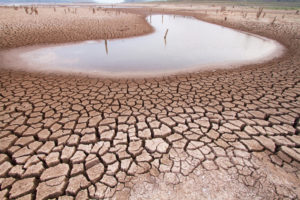
We’re hearing a lot about drought these days – towns in California running out of water, Lake Powell shrinking to historically low levels, and the grassy hills behind my Montana home growing browner and crispier by the day.
It’s scary – the physical embodiment of how a writing drought feels.
When my first book was published, I imagined some sort of steady upward trajectory, with a book a year and better sales each year, maybe even a bestseller someday. You know, the newbie’s dream.
The reality looked more like the ragged silhouette of the mountains that define western Montana – a few peaks that catch and hold the sunlight, and lots of very deep, dark valleys.
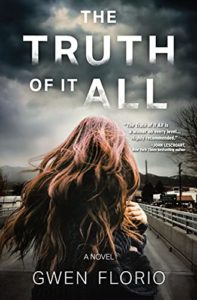
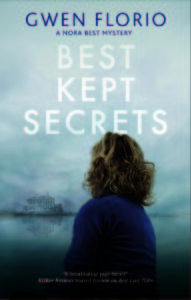
I have the good fortune of being on a bit of a peak right now, with one book – The Truth of It All (Crooked Lane) – coming out Aug. 10, and another – Best Kept Secrets (Severn House) – Sept. 7.
It makes me look incredibly productive, but the truth involves the pandemic’s effect on both submissions and publishing deadlines.
When the book that became The Truth of It All, featuring young public defender Julia Geary, failed to immediately find a home, I started writing the Nora Best series for Severn House. Once the pandemic hit, I figured Julia would never see the light of day.
Turns out there’s a reason for the adage “Never say never.”
It’s a good reminder not to get too discouraged by the many droughts in the publishing business. I know people who’ve had bestsellers followed by long dry spells.
I’m way too well acquainted with drought. It’s no fun, but there’s a glass-half-full aspect to it, which is that it can force you to focus on what’s really important: the writing itself.
The two books coming out in the next few weeks will be my eighth and ninth, something that’s still hard for me to believe.
If I’ve learned anything beyond the fact that making an outline is truly a good idea, it’s that the longer I do this, the more I realize that getting the damn sentences right is what gives me the most fulfillment.
Although, I wouldn’t mind a bestseller!
(*in my books )
It’s always fun/stressful to come up with new and inventive ways to kill people in crime novels – which, by their very nature, require a body or two. Occasionally, too, a protagonist finds herself in a fight to the death, which in turn generally requires a weapon of some sort.
I tend to shy away from guns, for the sole reason that it’s way to easy to get something about them wrong and then you look like an idiot and readers cease to trust you.
So, instead I’ve used for actual and attempted slayings:
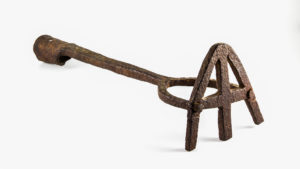

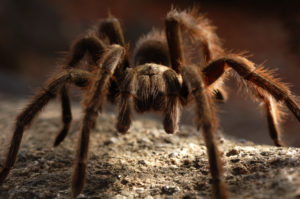
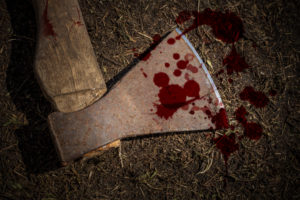

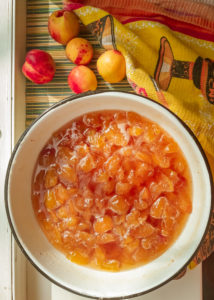
Most these required internet research into the types and efficacy of the injuries they’d cause. The photos accompanying that research would make the goriest slasher film look kindergarten-worthy by comparison. And, like every other crime writer I know, there’s always the fear of ending up on some weird watch list as a result.
Anyhow, I’m about 15,000 words into a new manuscript and am already starting to contemplate the lethal weapon I’ll eventually need.
If I’m honest, I’ll admit to some anticipation, too. Because what’s the strangest, yet most believably deadly thing I can come up with? One that’ll top the peaches?
Stay tuned.
I’ve just started a new novel and this time, this time, FOR REAL, I’m going to use an outline.
Oh, ha ha ha. I crack myself up.
But at least I’ve taken baby steps toward one, by writing a synopsis. The first draft of my most recent novel (and, let’s face it, every one before it) was an unholy mess, involving characters and scenes that ended up on the cutting room floor, which meant I wasted tons of time on stuff that never made it into the final version. It was the first time I had to push a deadline, although luckily the pandemic pushed it for me, with a much-delayed publishing date.
Still, lesson learned. I vowed never to put myself through that again.
But an outline! Sitting down to write every day knowing what was going to happen? On one level, it sounds lovely. On another, I’d really miss the surprise of the just-right plot twist that occurs out of nowhere when I’m stuck.
Hence, the synopsis, something that leaves plenty of room for improvisation, but provides enough guidance to keep me from straying too far into the weeds.
A few weeks ago, I signed up for a virtual and extremely helpful Rocky Mountain Fiction Writers program by Sharon Mignerey on “Writing the Dreaded Synopsis.” Armed with newfound knowledge, I filled out a handy chart with characters, plot twists and subplots.
Turned out pretty well, if I say so myself. But something was missing.
Oh. That.
With every book, my wonderful and supremely patient agent, Richard Curtis, has given me the gentlest of nudges. “What about the love story?”
By which I think he means sex, but whatever.
Once again, when figuring out what the hell was going to happen next, I’d forgotten to add something besides ambition and fear to set my protagonist’s heart pounding.
So, in the final blank space under subplots, I wrote:
Some sort of love thing,
I wonder what it will be?
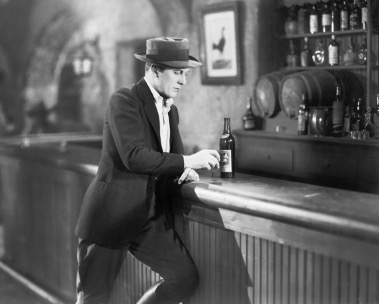
I recently gave a workshop that included a section on tropes – you know, the alcoholic detective, the hooker with a heart of gold, the pretty teenage victim – things that exist because of an element of truth, but that quickly become wearying.
Change ‘em up, I said. Give that victim some agency (Tim Johnston’s Descent is my favorite example here.)
Hardly original advice, illustrated far better than I by Halley Sutton’s recent column on noir tropes for CrimeReads:
Those tropes are both a challenge and an opportunity for writers: there’s so many ways to become a cliche, low rent Raymond Chandler, and also so many opportunities to remake something out of the familiar into something new.
I really liked her focus on noir, especially when she confessed that her definition is one to which I also default: I know it when I see it.
A few years back I was fortunate enough to be asked to contribute a piece to one of Akashic Books’ terrific noir series; in this case Montana Noir. I love the way the entire concept of that book turned the noir trope – urban alleyways cloaked in damp, swirling fog — on its head. If you think the mean streets of LA are scary, wait until you find yourself on a Montana prairie with no law enforcement for fifty miles.
My main character in that story was a hapless student in an MFA program, and the full-figured femme fatale lived in a house trailer and favored peasant blouses over negligees. She also kicked his ass.
In retrospect, I realize I applied my own advice about tropes to that story (whew). I wish I could say I did it purposefully, but I think it had more to do with the fact that I was too freaked out to try and emulate classic noir, so I tried something different.
I had a lot of fun writing that story, which I suppose is the message here, as much as there is one: If you enjoy what you’re writing, chances are your readers will, too.
